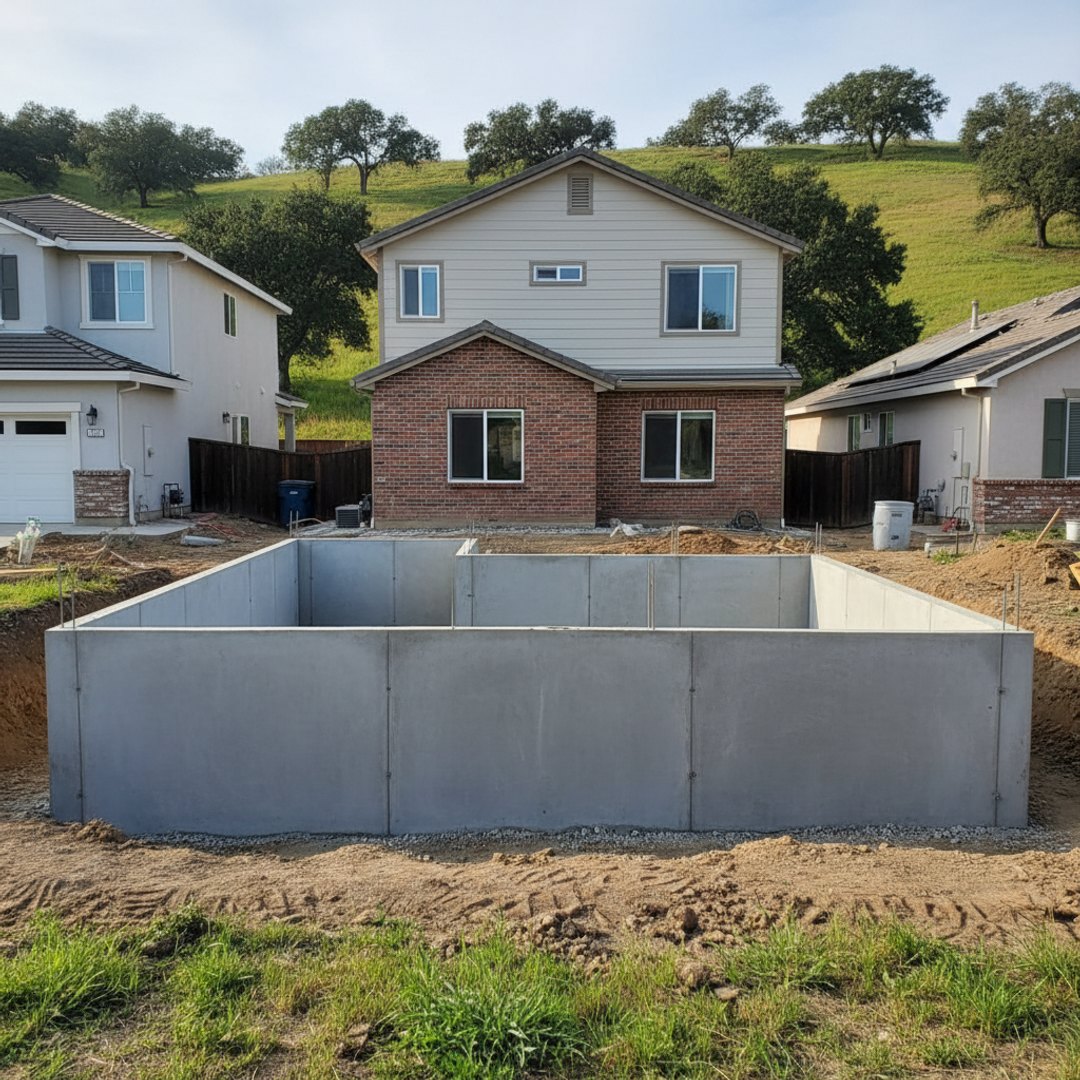
Concrete looks simple once it's down. Grey, flat, done. But what happens before the truck shows up decides whether that slab lasts twenty years or starts cracking and heaving in the first rainy season. San Jose has its own set of conditions that make this more than a generic pour, and most of the problems we get called out to fix trace back to one of these ten things never getting checked.
What's actually under the lot
A lot of the valley floor sits on clay, and in older neighborhoods like Willow Glen, Rose Garden, and Naglee Park that clay runs heavy, sometimes close to the old adobe soils the area is known for. Clay shrinks when it dries and swells when it's wet, and that movement under a slab is what causes the cracking and the "why is my patio tilting toward the house" calls we get every spring. If your yard has standing cracks in the dirt during a dry August, that's your clay telling you what it does. A proper base, usually 4 to 6 inches of compacted aggregate, matters more here than in sandy soil areas because it breaks the direct contact between the slab and that expansive clay underneath.
Newer subdivisions out in Evergreen, Almaden Valley, and Coyote Valley are often built on engineered fill pads, which behave more predictably, but fill isn't the same everywhere on the lot. A soil test isn't always necessary for a patio, but for a foundation or a retaining wall over a few feet tall, it's worth asking your contractor whether one's been done nearby.
Where the water goes when it rains
San Jose gets most of its rain between November and March, usually 14 to 15 inches a year total, concentrated into a handful of heavy weeks rather than spread evenly. The rest of the year is dry enough that people forget drainage matters at all, until the first real storm in November sends water sheeting across a flat patio and into the back door. Every slab we pour gets a slope, generally a quarter inch per foot away from the house, and if your existing yard pitches toward the foundation instead of away from it, that's worth fixing before new concrete goes in, not after.
Streets in the older grid neighborhoods rely on curb and gutter systems that were sized decades ago. A driveway apron that dumps water into the gutter at the wrong angle can get flagged during inspection, or just cause pooling at the curb that freezes nobody here worries about, but does sit and stain.
What's already buried there
Before anyone digs, call 811 and get utility lines marked. It's free, it takes a couple of business days, and it's the difference between a clean excavation and hitting a gas line or an irrigation main you forgot existed. Older homes in central San Jose often still have clay sewer laterals from the 1930s through 1950s, and those are shallow enough that a driveway excavation can crack one without anybody noticing until the yard starts smelling or sinking a few months later. If your house predates 1960, it's worth asking what's down there before the excavator starts.
Permits, setbacks, and the HOA question
The City of San Jose requires permits for most structural concrete work, including new slabs tied to a foundation, retaining walls over roughly 4 feet, and any work that cuts into the public sidewalk or curb for a driveway apron, which falls under an encroachment permit handled separately from the building permit. A straightforward patio replacement poured within your own property line often doesn't need one, but anything touching the right-of-way, or anything load-bearing, does, and skipping that step can mean a stop-work order mid-project or trouble later when you sell the house.
If you're in one of the newer planned communities, Silver Creek, Communications Hill, parts of Almaden, there's a decent chance an HOA has a say in color, finish, or even the stamped pattern on a driveway. That approval can take a few weeks, so it needs to happen before material gets ordered, not after.
- Setback requirements matter for retaining walls and additions near a property line, and a survey is worth the cost if you're not sure exactly where that line sits.
- Permit review for a residential slab or wall usually takes about one to three weeks in San Jose, longer if engineering drawings are required.
- Inspections typically happen at the base and rebar stage, before the pour, and sometimes again after.
The pour itself: thickness, reinforcement, and joints
A patio or sidewalk is usually poured 4 inches thick. A driveway that'll see a car and the occasional moving truck needs 5 to 6 inches, sometimes more if it's also the access route for an RV or a boat trailer. Reinforcement matters more than people expect: welded wire mesh has its place, but for anything carrying real weight, rebar tied into a grid, often #3 or #4 bar, holds up better over time because mesh tends to sag to the bottom of the pour and stops doing its job.
Control joints are cut to tell the slab where to crack, because it's going to crack somewhere eventually. The rule of thumb is roughly 2 to 3 times the slab thickness in feet as the joint spacing, so a 4-inch slab gets joints every 8 to 10 feet. We saw-cut those joints within 24 hours of finishing, sooner if it's a hot day, because waiting too long means the slab has already decided where to crack on its own, and it won't be a straight line.
Timing, heat, and when you can actually use it
Concrete reaches about 70 percent of its strength in the first week and keeps curing for 28 days total. In practice that means you can walk on a new slab in a day or two, but you shouldn't park a car on a new driveway for at least 7 days, longer if the weather's been cool. San Jose summers push into the 90s inland through July and August, and that heat speeds up evaporation on the surface faster than the concrete underneath can keep up, which causes surface cracking if it's not cured properly with a compound or wet burlap. On the other end, pouring right before a November rain is asking for trouble, since rain hitting fresh concrete before it sets weakens the surface and leaves it dusty or scaled.
None of this is complicated once somebody walks you through it, but it's the kind of detail that gets skipped when a job is priced and scheduled too fast. If you're planning a driveway, a patio, a repair, or a new foundation slab anywhere in San Jose or the surrounding towns, Omega Concrete can walk the site with you before anything gets ordered, so the questions above get answered before the truck shows up instead of after.